Tool Review
FullEnrich review and pricing
Fast buying check
If you are comparing FullEnrich pricing or reading FullEnrich reviews, the useful question is whether waterfall enrichment can turn your existing lead lists into more reachable prospects before outreach.
Reviewed by QuestStack Editorial Team on August 30, 2026 · 6 min read. Review current See our scoring method.
Evidence level: public-source editorial assessment. 4 linked primary sources; no authenticated workflow test is claimed unless a test record is explicitly shown on this page.
Decision Summary
FullEnrich review and pricing
If you are comparing FullEnrich pricing or reading FullEnrich reviews, the useful question is whether waterfall enrichment can turn your existing lead lists into more reachable prospects before outreach.
Best for
B2B sales, RevOps, and agency teams that need verified work emails and mobile numbers from a waterfall enrichment workflow before outreach.
Not ideal for
It enriches contact data, but does not replace sequencing, social intent monitoring, or a CRM
When to choose it
Choose FullEnrich when this buyer profile matches your needs: B2B sales, RevOps, and agency teams that need verified work emails and mobile numbers from a waterfall enrichment workflow before outreach. It is strongest when value for money and ease of use matter most.
Pricing checked on
August 30, 2026 · Pricing current
Official pricing sourceUse the recently verified free entry point before considering a paid plan.
Pricing Snapshot
$55/month
Why click out now
Use the vendor page to confirm live plan details, trial availability, and whether the buying motion still matches this review.
Compare first
FullEnrich vs GojiberryStart with one direct comparison before you click out or browse the full alternatives set.
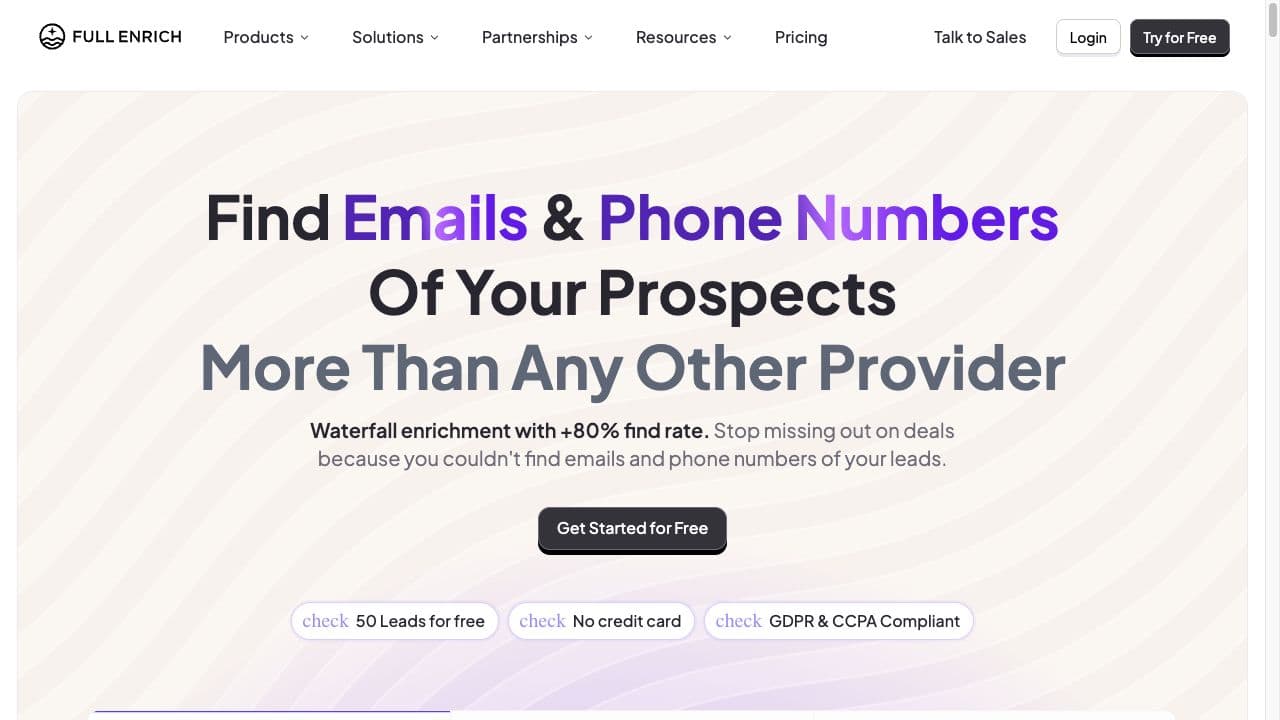
Public product view
What FullEnrich currently presents to buyers
Captured from the official public website. This supports the positioning notes in the review but is not an authenticated product-workflow test.
Pricing Snapshot
Use this table to pressure-test whether the commercial model matches the workflow you actually need.
Public entry price
FullEnrich offers 50 free credits with no card; the 1,000-credit Pro configuration is $55/month.
Trial access
The current site promotes 50 free credits with no credit card so teams can test enrichment against a real prospect list.
Best cost signal
The spend is easiest to justify when FullEnrich replaces several enrichment vendors, separate credit systems, and manual verification work.
Watch first
Phone-heavy workflows burn credits faster than email-first workflows, so model email, phone, and personal-email volume before scaling.
Official Sources and Pricing Checks
These are the live vendor pages behind the pricing, feature, and workflow notes used in this FullEnrich review.
- Official product site
Current waterfall enrichment positioning, free credit offer, coverage claims, compliance notes, and product overview.
- Pricing
The 50-credit no-card start, $55 monthly 1,000-credit configuration, rollover terms, and per-data-type costs verified August 30, 2026.
- Integrations
Official integration coverage for Clay, Zapier, Make, n8n, HubSpot, API workflows, and early-access sales stack integrations.
- Product introduction
Official help article explaining waterfall enrichment, provider sequencing, and global coverage positioning.
Buyer Questions
What is FullEnrich best for?
FullEnrich is best for B2B sales, RevOps, and agency teams that already have lead lists and need verified work emails or mobile numbers before outreach.
How should teams evaluate FullEnrich pricing?
Evaluate FullEnrich pricing by modeling credits against the contacts you actually need. Work emails, mobile numbers, personal emails, and reverse lookups use credits differently, so the right plan depends on your data mix.
What should you compare before choosing FullEnrich?
Compare FullEnrich with Gojiberry if you need outbound execution, Leadverse if you need social-intent discovery, and Bazzly or Replymer if Reddit and public-thread workflows matter more than contact enrichment.
Pros
- Waterfall enrichment checks 20+ premium data sources instead of relying on one static contact database
- Credits are only used on successful data finds, with email, phone, personal email, and reverse lookup options
- API, CSV, Clay, Zapier, Make, n8n, and HubSpot workflows make it practical for outbound operations
Cons
- It enriches contact data, but does not replace sequencing, social intent monitoring, or a CRM
- Phone-heavy workflows can consume credits quickly because mobile numbers cost more than work emails
- Data quality still depends on the quality and freshness of the source lead list
Loadout Features
- Work email, mobile phone, personal email, reverse email, and person or company enrichment
- Waterfall enrichment across 20+ data vendors with validation before credits are charged
- Bulk CSV enrichment, workflow integrations, API access, and CRM handoff
Trial, Integrations, and Buying Motion
Buying motion
FullEnrich uses a free 50-credit start, paid credit bundles from $55/month for 1,000 credits model. Free signup or entry point; no fixed trial duration is published · no card required.
Integrations
Clay, Zapier, Make, n8n, HubSpot.
Detailed Notes
In this FullEnrich review, the main thing to understand is that FullEnrich is a contact enrichment layer, not a full outbound platform. It helps teams find verified work emails and mobile numbers for prospects using a waterfall approach across many data sources.
Bottom line
FullEnrich is strongest when your team already has a lead source and needs better contact data before outreach. If you are exporting prospects from LinkedIn, building account lists in Clay, cleaning a CRM segment, or enriching inbound leads, FullEnrich can increase the reachable portion of that list without forcing you to manage several enrichment vendors yourself.
That focus is useful. A lot of sales software tries to do prospecting, enrichment, sequencing, inbox management, analytics, and CRM work in one platform. FullEnrich is narrower. It is designed to solve the specific problem of missing or unreliable emails and phone numbers.
The trade-off is that enrichment is not the same as demand generation. FullEnrich can help you reach more of the right people, but your team still needs a good source list, a clear ICP, and a thoughtful outreach motion.
What is FullEnrich?
FullEnrich is a B2B email and phone waterfall enrichment platform. Instead of checking one contact database, it routes each lookup through multiple premium data sources until it finds a verified result. The product currently positions this as a way to improve find rates across geographies and industries where single-source vendors often miss.
The workflow can enrich work emails, mobile phone numbers, personal emails, reverse email lookups, and person or company data. That makes FullEnrich most useful after you already know who you want to contact but before you launch outreach.
Where FullEnrich fits best
The best fit is a B2B sales or RevOps team that already has lead inputs from LinkedIn Sales Navigator, Clay, a CRM, a CSV, a product-led signup flow, or another prospect source. FullEnrich helps turn those lead records into usable contact records.
It belongs on the best AI lead generation tools shortlist because list quality and reachability are core parts of lead generation. It also belongs in sales outreach tools because better enrichment improves the top of the outbound funnel before a sequence ever starts.
FullEnrich pricing and credits
FullEnrich currently promotes a free start with 50 credits and no credit card. The August 2026 pricing check put the 1,000-credit Pro configuration at $55 per month, with higher-volume configurations lowering the per-credit price. Credits can be used across work email, mobile phone, personal email, reverse lookup, and standalone person or company data.
The important pricing detail is that different data types use credits differently. A verified work email costs fewer credits than a mobile phone number, so phone-heavy outbound teams need to model volume carefully. FullEnrich also says credits are only used when a result is found, which makes the effective cost depend on successful enrichment, not just lookup attempts.
For ROI, the practical question is not whether FullEnrich is cheap in isolation. It is whether it produces more usable contacts per dollar than the team's current enrichment stack. If one workflow replaces several vendors, separate credit systems, and manual validation, the value case gets much stronger.
Waterfall enrichment explained
Waterfall enrichment means FullEnrich tries multiple data sources in sequence. If the first provider misses, the workflow keeps going until it finds usable contact data or runs out of sources. The promise is higher coverage than a single vendor can provide by itself.
This matters most for teams selling across multiple regions. A vendor that performs well in the United States might be weaker in EMEA, LATAM, or APAC. FullEnrich's waterfall model is meant to smooth out those regional gaps by selecting from many sources rather than betting on one database.
The benefit is coverage. The trade-off is cost discipline. If your team enriches every low-priority record, the waterfall can still waste budget even when the data quality is good. The best use case is enriching a prioritized list where every contact has a reason to be in the outreach queue.
Integrations and workflow fit
FullEnrich is practical because it does not require every team to work inside the FullEnrich UI. The current integrations page highlights Clay, Zapier, Make, n8n, HubSpot, and API workflows, with other CRM and outreach integrations in early-access paths.
That makes the product useful for operations teams. A RevOps owner can enrich leads inside Clay, trigger enrichment through Zapier or Make, push and pull contacts through HubSpot, or connect the API to an internal workflow. FullEnrich is easiest to justify when enrichment becomes part of the operating system, not a one-off export task.
FullEnrich vs Gojiberry
FullEnrich vs Gojiberry is a data layer versus outbound execution decision. FullEnrich is better when the team already has leads and needs verified emails or phone numbers. Gojiberry is better when the team needs signal-led lead discovery, AI outreach, demo booking support, and CRM handoff in one motion.
Choose FullEnrich if the bottleneck is missing contact data. Choose Gojiberry if the bottleneck is finding warm accounts and turning them into outbound campaigns.
FullEnrich vs Leadverse
FullEnrich vs Leadverse comes down to source of intent. Leadverse watches public conversations on Reddit, X, and LinkedIn so teams can respond while buying intent is visible. FullEnrich takes a known lead list and improves the contact fields needed for email or phone outreach.
If your prospects are already talking publicly, Leadverse can be the discovery layer. If your prospects are already in a spreadsheet, CRM, Clay table, or LinkedIn export, FullEnrich can be the enrichment layer.
FullEnrich vs Bazzly and Replymer
FullEnrich vs Bazzly and FullEnrich vs Replymer are similar decisions. Bazzly and Replymer are conversation-led tools for finding or acting on public threads. FullEnrich is contact-data infrastructure for outbound lists.
That means these tools can be complementary. A team might use a public-intent tool to find a company or buyer signal, then use FullEnrich to find verified contact data for a more structured follow-up. But if you only need one first, choose based on the current bottleneck: intent discovery or reachability.
Who should skip FullEnrich?
Skip FullEnrich if your team does not have a clear list-building motion yet. Better emails and phone numbers will not fix a weak ICP or a generic offer. It also is not the right first tool if you mainly need sequencing, inbox rotation, copy generation, or social reply management.
You should also be careful if you are phone-first at high volume. Mobile numbers cost more credits than work emails, so the plan that looks generous for email enrichment may feel much tighter when most lookups are phones.
Decision checklist
Before choosing FullEnrich, ask:
- Do we already know which accounts or people we want to reach?
- Are missing emails or mobile numbers blocking outreach volume?
- Will CSV, Clay, Zapier, Make, n8n, HubSpot, or API workflows reduce manual operations?
- Are we prioritizing leads before enrichment so credits go toward high-fit prospects?
- Do we need enrichment only, or a broader outbound execution platform?
If the answers point to reachability and data quality, FullEnrich is a strong shortlist pick. If they point to prospect discovery, sequencing, or social listening, compare FullEnrich vs Leadverse before buying.
Final verdict
FullEnrich is a strong fit for B2B teams that need better verified contact data without building and maintaining their own waterfall across multiple vendors. It is especially compelling when enrichment needs to plug into Clay, HubSpot, no-code automations, CSV workflows, or an internal API flow.
The best buying rule is simple: choose FullEnrich when the list is already targeted and the contact data is the constraint. If the target list itself is weak, fix the sourcing motion first. FullEnrich can make good lists more reachable, but it should not be used to make bad lists louder.
How We Reviewed FullEnrich
This public-source assessment uses the same criteria for every tool: ease of use, feature depth, value for money, support, and integration flexibility. The evidence and scoring notes are tied to our published review policy. Published reviews keep their original evidence and editorial context.
Alternatives
Reviewed alternatives to FullEnrich
These are the closest alternatives in QuestStack's reviewed inventory. Use the direct comparisons where available, then verify current pricing and workflow fit in each full review.
Gojiberry
Founder-led B2B sales teams that want warm lead discovery, AI outreach, and cleaner CRM handoff without stitching together a heavier outbound stack.
Leadverse
Founders, agencies, and lean outbound teams that want to find and respond to high-intent Reddit conversations instead of building cold lists from scratch.
MyFeedIn
LinkedIn-focused founders, creators, consultants, and lean sales teams that want custom feeds, engagement lists, analytics, CRM pipeline, and lightweight outreach without living inside the default LinkedIn feed.
RedShip
Founders and marketers that want to monitor Reddit for buyer-intent conversations, score opportunities, and draft helpful replies without manually searching every day.
Bazzly
Founders and lean outbound teams that want Reddit lead discovery plus either approval-based replies from their own account or a managed autopilot workflow.
Replymer
SaaS founders and lean growth teams that want managed Reddit and X recommendation coverage, with real humans handling discovery, writing, and publishing instead of doing manual social selling themselves.
Major options not yet scored by QuestStack
These direct, non-affiliate official-site links broaden the market view without placing unreviewed products in the numbered score model.
Apollo
Sales intelligence and engagement platform; not yet scored by QuestStack.
Official websiteClay
Data enrichment and outbound workflow platform; not yet scored by QuestStack.
Official websiteZapier
Large no-code automation platform; not yet scored by QuestStack.
Official websiteMake
Visual workflow automation platform; not yet scored by QuestStack.
Official websiten8n
Workflow automation with cloud and self-hosted paths; not yet scored by QuestStack.
Official websiteNeed broader options? Browse all FullEnrich alternatives.
Compare FullEnrich directly
FullEnrich vs Bazzly
Compare pricing fit, workflow depth, and the clearest reason to choose FullEnrich or Bazzly.
FullEnrich vs Gojiberry
Compare pricing fit, workflow depth, and the clearest reason to choose FullEnrich or Gojiberry.
FullEnrich vs Leadverse
Compare pricing fit, workflow depth, and the clearest reason to choose FullEnrich or Leadverse.
FullEnrich vs MyFeedIn
Compare pricing fit, workflow depth, and the clearest reason to choose FullEnrich or MyFeedIn.
FullEnrich vs Replymer
Compare pricing fit, workflow depth, and the clearest reason to choose FullEnrich or Replymer.
FullEnrich vs RedShip
Compare pricing fit, workflow depth, and the clearest reason to choose FullEnrich or RedShip.